Key takeaways
- Carriers size a job in pallet spaces, based on the standard Australian pallet of 1165 × 1165 mm.
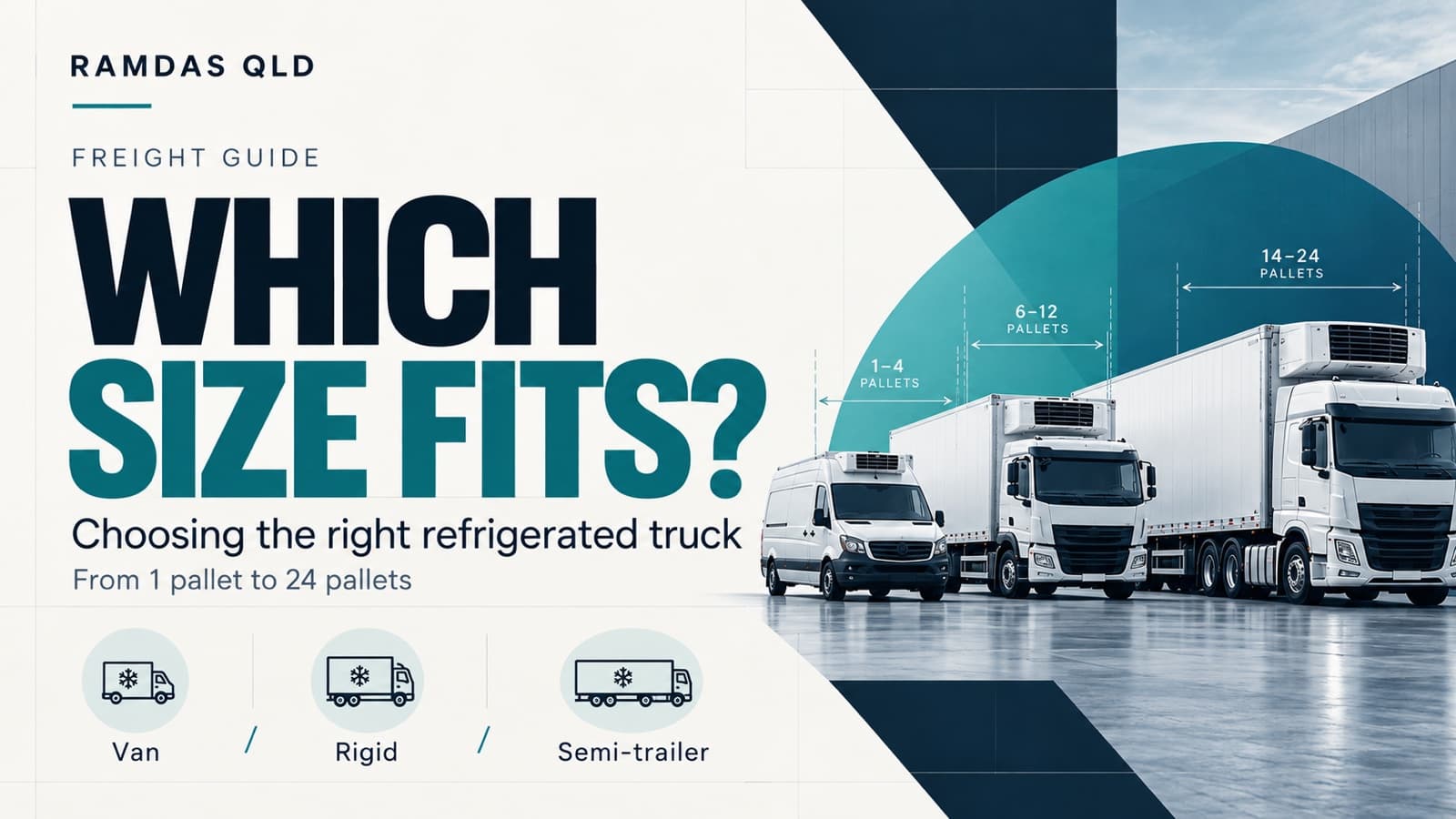
- Typical capacity runs from 1 pallet in a van to 22–24 pallets on a semi-trailer.
- Dense product such as meat, dairy and liquids can reach the weight limit before the floor is full.
- Chilled and frozen food usually cannot be double-stacked, and nothing should sit above the load line.
- Access at the pickup and delivery sites often decides the truck more than the freight does.
On this page
The size of refrigerated truck you need comes down to three things: how many pallet spaces your freight takes up, how much it weighs, and what can physically get into the pickup and delivery sites. As a rough guide, one pallet, or the same volume in loose cartons, fits a refrigerated van, 2–4 pallets a small truck, 6–10 a medium truck, 12–14 a large truck and 22–24 a semi-trailer.
Those figures are typical for our fleet rather than an official standard, and the right answer for your load can shift up or down a class once weight and access are counted. The sections below work through each factor.
The Australian pallet and why carriers quote in pallet spaces
The standard Australian pallet is 1165 × 1165 mm. Truck bodies are built around that footprint, so a carrier thinks of a vehicle’s floor as a number of pallet spaces rather than as square metres.
A pallet space is the floor area one standard pallet occupies. Freight that overhangs the pallet, sits on an oversize or imported pallet, or cannot be placed hard against its neighbour may take more than one space. If your pallets are not the standard size, give the carrier the actual dimensions.
Refrigerated vehicle classes and typical capacity
| Vehicle | Typical capacity | Temperature range | Suits |
|---|---|---|---|
| Refrigerated van | 1 pallet equivalent, up to 1 tonne | −20°C to +8°C | Cartons, urgent top-ups, cafes, CBD and shopfront deliveries |
| Small truck | 2–4 pallets | −20°C to +8°C | Butchers, caterers, small manufacturers, tight streets |
| Medium truck | 6–10 pallets | −25°C to +10°C | Metro multi-drop runs, wholesale and store deliveries |
| Large truck | 12–14 pallets | −25°C to +10°C | Larger distribution loads, regional runs |
| Semi-trailer | 22–24 pallets | −25°C to +10°C | Full loads, linehaul, produce out of growing regions |
| Multi-temperature trailer | Split between zones | Chilled and frozen in separate zones | Mixed orders on one delivery |
An “8 pallet truck” sits in the medium class. Bodies in the same class differ from one to the next, so treat the count as a range. Our fleet page describes each vehicle in more detail.
Weight, space and height: which limit you reach first
Every vehicle has a floor-space limit and a payload limit. Light, bulky freight such as leafy vegetables, bread or packaged salads fills the floor long before it reaches the weight limit. Dense freight such as boxed meat, dairy, juice and other liquids does the opposite, and the truck is at its legal weight with empty pallet spaces left over.
Refrigerated bodies are also heavier than dry ones. The insulation and the refrigeration unit come out of the payload, so a refrigerated truck carries less weight than a dry truck of the same size. Payload depends on the individual vehicle, which is why a carrier asks for weight per pallet and not just a pallet count.
Declaring weight accurately is a legal matter as well as a practical one. A business that consigns goods by heavy vehicle is a party in the Chain of Responsibility and shares the duty to make sure the load is safe and within limits.
Height, airflow and the load line
A refrigerated body keeps product cold by moving air around the load. Pallets stacked too high block that airflow, so refrigerated bodies have a load line, usually marked on the wall, and freight should never be loaded above it. The warmest point in a vehicle is usually at the top, near the doors, which is where an over-height pallet ends up.
Double-stacking is usually not possible for chilled and frozen food: cartons crush, and the upper pallet sits in the airflow path. Plan on one pallet per floor space, tell the carrier the stacked height of each pallet, and ask for the maximum height if yours are tall.
Cartons not on pallets: how to estimate
Loose cartons are common on van and small-truck work. To turn a carton count into pallet spaces, use the pallet footprint as a template.
- Measure one carton: length, width and height.
- Work out how many cartons fit in one layer on a 1165 × 1165 mm footprint without overhang.
- Decide how many layers stack safely without crushing the bottom cartons.
- Multiply cartons per layer by layers to get cartons per pallet space.
- Divide your total carton count by that figure, and round up.
- Multiply carton weight by the total count for the load weight.
If that is more arithmetic than you want, send the carton dimensions, the count and the weight per carton, and the carrier will do it.
Chilled and frozen on the same delivery
Chilled and frozen product cannot share one compartment. A multi-temperature vehicle uses a movable bulkhead and separate evaporators to hold two zones at different set points, with frozen product loaded nearest the evaporator.
The bulkhead takes up some floor, and each zone has to be sized to its share of the load. Give the split when you book, for example six pallets chilled and two frozen, rather than a single total. Our guide to chilled vs frozen transport temperatures covers the set points for common products.
Site access often decides the truck
A load that fits neatly on a large truck is no use if the truck cannot reach the door. Check these at both the pickup and the delivery address.
- Dock or kerbside. A raised dock suits larger vehicles. Kerbside delivery needs a tailgate lift or hand unloading.
- Forklift or pallet jack. Without one, pallets may have to be broken down and carried in by the carton.
- Street width and turning room. Laneways, residential streets and older industrial estates can rule out anything bigger than a small truck.
- Height clearance. Awnings, basement docks and car park entries all have limits.
- CBD and shopping centre rules. Loading zones, dock booking systems and delivery hours vary from site to site.
Sometimes the answer is two smaller vehicles, or a larger truck for the linehaul and a smaller one for the final delivery. That changes the price, which our article on refrigerated transport costs in Queensland explains.
What to do next
Before you request a quote, write down the following for your load. With these seven details a carrier can pick the right vehicle the first time.
- Number of pallets, or cartons with dimensions.
- Pallet type and size if not standard.
- Stacked height of each pallet.
- Weight per pallet, or total weight.
- Product and temperature, with the chilled and frozen split if mixed.
- Access at pickup and delivery: dock, forklift, kerbside, any restrictions.
- Number of drops.
Then send them through our quote form or call dispatch. If the load is only a few pallets, read our guide to part-load refrigerated pallet freight first, because you may not need a whole truck.
Frequently asked questions
How many pallets fit in a refrigerated truck?
It depends on the vehicle class. Typically a small truck carries 2–4 pallets, a medium truck 6–10, a large truck 12–14 and a semi-trailer 22–24, subject to weight.
What can a 1 tonne refrigerated van carry?
A refrigerated van typically carries the equivalent of one pallet, up to about 1 tonne, usually as loose cartons. It suits small urgent deliveries and sites with tight access.
What are the dimensions of a standard Australian pallet?
The standard Australian pallet is 1165 × 1165 mm. Imported pallets are often a different size, so tell your carrier if yours are not standard.
Can refrigerated pallets be double-stacked?
Usually not for chilled and frozen food. Stacking risks crushing cartons and blocks the airflow that keeps the load cold, so plan on one pallet per floor space.
Can chilled and frozen goods go on the same truck?
Yes, on a multi-temperature vehicle, which uses a movable bulkhead to hold chilled and frozen product in separate zones. Tell the carrier how many pallets are in each temperature.
Ramdas QLD dispatch team
Refrigerated transport, Brisbane
Written by the people who plan and run Ramdas QLD's chilled, frozen and multi-temperature freight across Brisbane and Queensland. About us
Sources
General information only — check the current standard or your regulator for requirements that apply to your product.