Key takeaways
- Ask every carrier the same nine questions and compare how specific the answers are.
- Proof matters more than promises: ask for probe readings at pickup and delivery, not just an assurance the fridge was on.
- HACCP certification is usually a customer requirement, not a blanket legal one, so ask to see current documents for your product.
- Tracking systems differ between carriers; find out exactly what updates you will get and who answers the phone.
- Run a trial load before you commit regular freight to anyone.
On this page
To choose between refrigerated transport companies in Brisbane, ask each one the same nine questions: how they prove temperature, what vehicles and backup they have, whether they can carry your temperature, what food-safety documents they hold, how you will get updates, who you talk to, where and how often they run, what happens when something goes wrong, and how pricing works. The carrier with specific answers is usually the one to trial.
Websites all say much the same thing. The answers to these questions do not.
The nine questions at a glance
| Question | What a good answer sounds like | Red flag |
|---|---|---|
| 1. Do you pre-cool the vehicle, and how do you prove product temperature? | Vehicle pre-cooled before loading. Product probed at pickup and delivery, with readings kept and supplied on request. | “The fridge was on the whole way”, with nothing written down. |
| 2. What vehicles do you run, and what is the backup if one breaks down? | Names the vehicle sizes that suit your load and describes an actual plan for a breakdown. | “That never happens.” |
| 3. Can you carry my temperature, and mixed chilled and frozen? | Asks for your product specification and explains how zones are separated. | One setting for everything, or no questions about your product. |
| 4. What food-safety program or accreditation covers my product? | Explains what they hold and shows current documents. | Claims a certification but cannot produce the certificate. |
| 5. How will I know where my freight is? | Describes exactly what you receive and when. | Promises “real-time tracking” but cannot show you what it looks like. |
| 6. Who do I actually talk to? | A named person or dispatch desk with a direct number and stated hours. | A generic inbox only. |
| 7. What areas do you cover, and how regularly? | Clear about which areas are regular runs and which are on request. | “Anywhere, any time”, with no detail. |
| 8. What happens when something goes wrong? | You are phoned early, records are shared and there is a process for rejected loads. | Vague answers, or blame placed on receivers in advance. |
| 9. How is pricing structured, and what are the extras? | Explains what drives the price and lists extras in writing up front. | A single figure with no terms attached. |
Temperature and food safety: questions 1 to 4
Pre-cooling and proof. Refrigerated vehicles hold product at the temperature it was loaded at; they are not built to chill it down. The Australian Cold Chain Guidelines say to pre-chill the vehicle before loading and to record product temperature at receipt and delivery, along with an air temperature log. Ask which of those records you can have and how quickly.
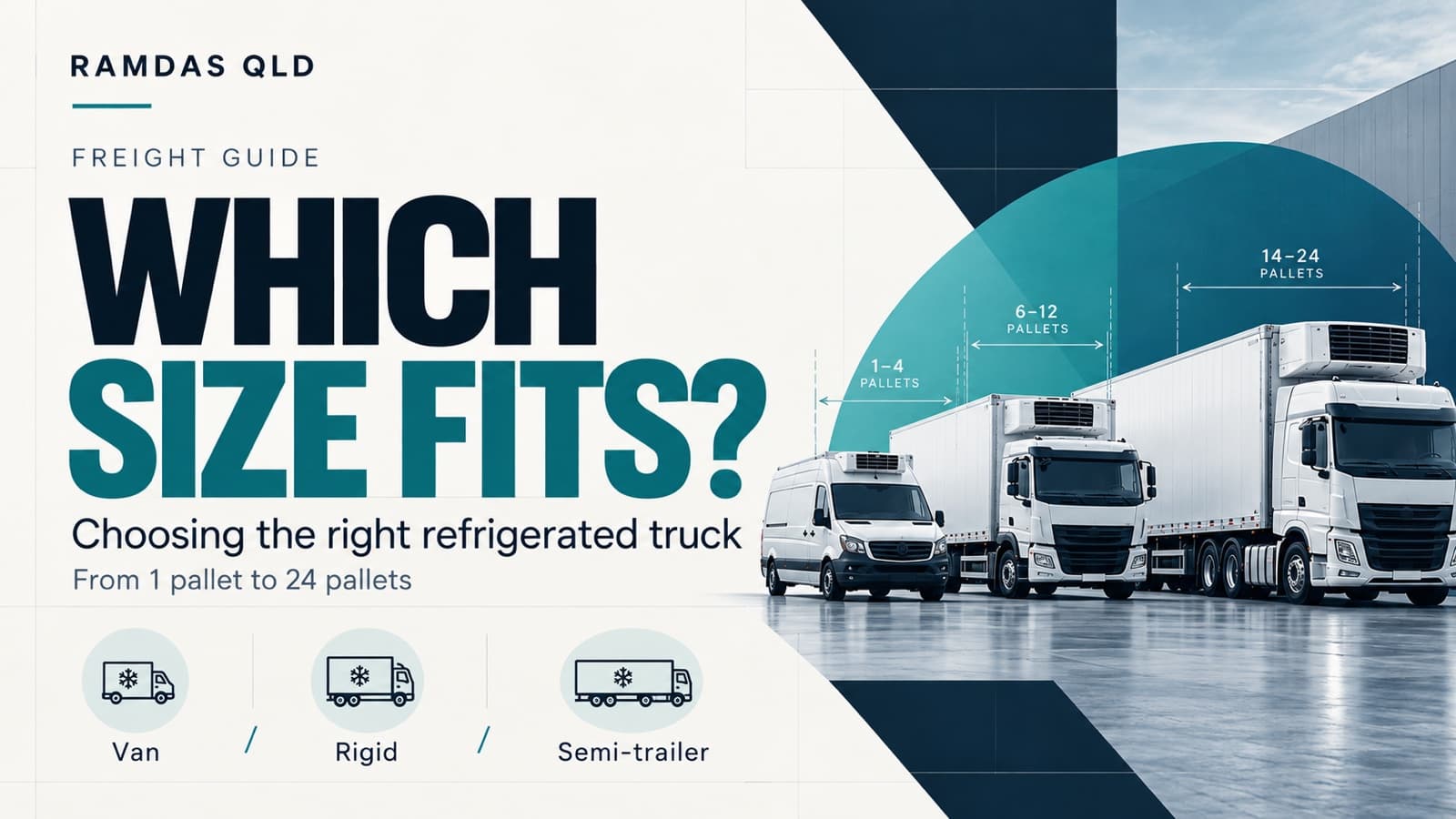
Vehicles and backup. A carrier should match the vehicle to your load, not send whatever is free. Ask what sizes they run and compare them with what you send; our guide to what size refrigerated truck you need helps. Then ask what happens to your freight if that vehicle or its refrigeration unit fails mid-run.
Your temperature, and mixed loads. Chilled food is commonly carried at 0–4°C and frozen at −18°C or colder, but some produce is damaged at those temperatures, and the product owner's specification is what counts. If you send chilled and frozen together, ask whether the carrier uses insulated partitions or a dual-temperature vehicle. Our chilled vs frozen transport temperatures guide covers the detail.
Food-safety program and accreditation. Every food business must comply with the Food Standards Code. HACCP certification, however, is not a blanket legal requirement for food transporters. It is usually something a customer or contract demands, so check what your own customers require of your carrier.
Communication and coverage: questions 5 to 7
Knowing where your freight is. Systems differ. Some carriers offer an online portal with live vehicle positions. Others send messages at set points and rely on a dispatcher who picks up the phone. Either can work. What matters is that you know which one you are getting before your receiver rings asking where the truck is.
Who you talk to. Ask for the name and number of the person who will handle your account, their hours, and who covers after hours while a truck is on the road.
Areas and frequency. A carrier may be excellent on Brisbane metro and only occasional to the Sunshine Coast or Toowoomba. Ask which of your delivery points are on regular runs and which would be a special trip.
Problems and pricing: questions 8 and 9
When something goes wrong. Every carrier eventually has a delay, a temperature excursion or a rejected delivery. Ask for a real example. You want to hear who phoned whom, how quickly, what records were shared, and where rejected product went.
Pricing and extras. Ask whether you are quoted per pallet, per drop, per kilometre or per vehicle, and what is charged on top: waiting time, tailgate or hand unload, after-hours delivery, re-delivery and fuel levies are common ones. Get it in writing so you can compare quotes like for like.
Small family operator or large national carrier?
Neither is automatically better. A large national carrier typically offers a wider network, more depots and vehicles to fall back on, and often a customer portal. The trade-off can be fixed processes, minimum volumes and a contact centre between you and dispatch.
A small or family operator typically offers direct contact with the people planning your freight, flexibility on small or unusual jobs and consistent handling. The trade-off is a smaller fleet, less depth if a vehicle is off the road, and simpler technology. Match the carrier to your freight: a few local drops a week and a national distribution contract are different problems.
Whichever you lean towards, run a trial. Send one or two ordinary loads, probe the product yourself before pickup, and ask your receiver for the arrival temperature and time. Then ask the carrier for their records and see whether the numbers agree.
How Ramdas QLD answers these questions
We are a family-owned refrigerated carrier based in Brisbane, so here are our own answers, kept to what we can stand behind.
- Temperature proof: vehicles are pre-cooled before loading. Calibrated probe readings are taken at pickup and delivery, kept on file and available with the POD on request.
- Vehicles: from a one-pallet refrigerated van to semi-trailers of 22–24 pallets; see our fleet. What happens in a breakdown depends on the run and the vehicle, so ask us about yours.
- Temperatures: chilled, frozen and fresh produce, plus multi-temperature loads using a movable bulkhead.
- Food safety: our handling routines are HACCP-aligned. Ask us for current documents relevant to your product, as you would any carrier.
- Updates: dispatch sends SMS and email updates at pickup, in transit and at delivery. We do not have a live-GPS customer portal.
- Who you talk to: our office is open 8 am to 8 pm, seven days, and dispatch supports active runs around the clock.
- Areas: Brisbane, Gold Coast, Sunshine Coast, Ipswich, Logan and Toowoomba, with regional Queensland on planned services; see our service areas.
- Pricing: quoted per job from your freight details. We do not publish a rate card.
What to do next
Pick two or three carriers, send each the same freight details and the same nine questions, and compare the replies side by side. To include us, use the quote form and paste the questions into the message.
Frequently asked questions
How do I choose a refrigerated transport company in Brisbane?
Ask each carrier the same questions about temperature records, vehicles and backup, food-safety documents, communication, coverage, problem handling and pricing. Then run a trial load and compare their temperature records with your own.
Does a refrigerated carrier have to be HACCP certified?
HACCP certification is not a blanket legal requirement for food transporters in Australia; it is usually a customer or contract requirement. All food businesses must still comply with the Food Standards Code.
What temperature records should a refrigerated carrier give me?
Ask for the product temperature recorded at pickup and at delivery, along with the signed proof of delivery. Industry guidelines also recommend an air temperature log for the journey.
Is a small refrigerated carrier better than a large national one?
It depends on your freight. Large carriers typically offer wider networks and more backup vehicles, while small operators typically offer direct contact and flexibility, so match the carrier to your volumes and delivery points.
Do all refrigerated transport companies offer live GPS tracking?
No. Some offer an online portal with live positions, while others send SMS or email updates at pickup, in transit and at delivery. Ask each carrier exactly what you will receive.
Ramdas QLD dispatch team
Refrigerated transport, Brisbane
Written by the people who plan and run Ramdas QLD's chilled, frozen and multi-temperature freight across Brisbane and Queensland. About us
Sources
- Australian Cold Chain Guidelines 2017 (AFGC)
- FSANZ — Safe Food Australia (guide to Standard 3.2.2)
- Safe Food Production Queensland — FAQ
General information only — check the current standard or your regulator for requirements that apply to your product.