Key takeaways
- A carrier needs addresses, product, temperature, quantity, weight, ready time, receiving hours and contacts to quote accurately.
- More notice gives you more choice of vehicle and time; regular freight is best set up as a standing schedule.
- Product must be at temperature before pickup, because the vehicle maintains temperature and does not chill product down.
- Receivers check chilled food is at 5°C or below and frozen food is frozen hard, and can refuse a load that is not.
- As the consignor you have Chain of Responsibility duties: accurate weights, safe loading and realistic deadlines.
On this page
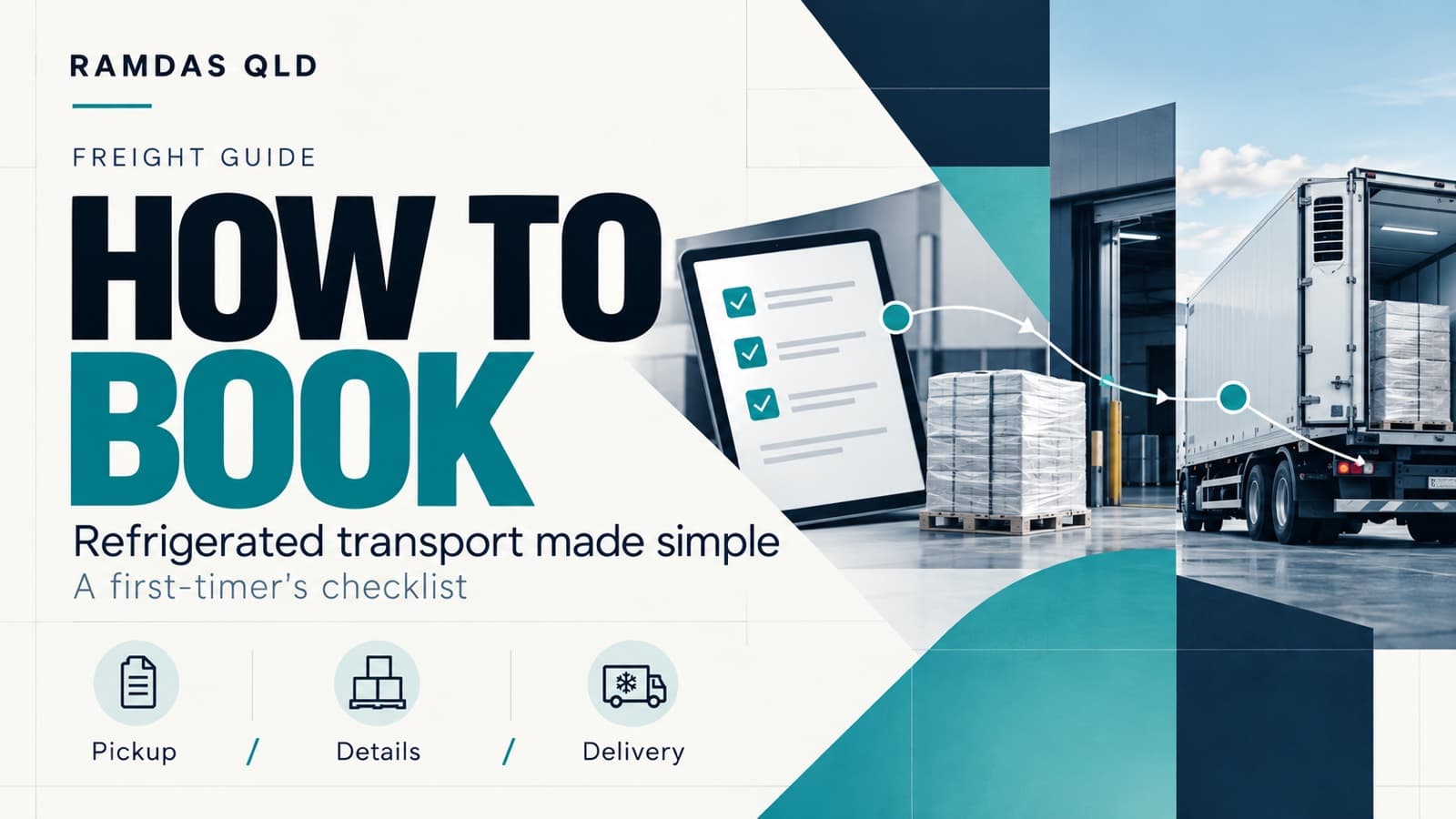
To book refrigerated transport, give the carrier the pickup and delivery addresses, what the product is, the temperature it must travel at, how much there is and what it weighs, when it will be ready, when the receiver can take it, and a contact at each end. Then have the product at temperature, wrapped and labelled before the truck arrives.
That is the whole job in two sentences. The rest of this guide takes each step in order, with checklists you can work through before your first booking.
What a carrier needs to quote
A quote is only as accurate as the details behind it. Send all of these at once and you avoid a day of back-and-forth.
| Detail | Why it matters |
|---|---|
| Pickup and delivery addresses | Distance and route set most of the price, and decide which run your freight can join. |
| Site access at each end | Dock or kerbside, height limits, forklift or hand unload. This decides the vehicle and how long each stop takes. |
| Product type | Meat, dairy, seafood, produce and frozen goods are handled differently and may not share space with some other loads. |
| Required temperature | Chilled, frozen or a specific set point. The product owner's specification is the one that counts. |
| Quantity and dimensions | Number of pallets or cartons and pallet height. A standard Australian pallet is 1165 × 1165 mm; say so if yours differ. |
| Total weight | Weight limits a load as much as floor space does, and the carrier must know it to load legally. |
| Ready time and date | The earliest a driver can load. A truck waiting on an unfinished order costs time for everyone. |
| Receiving hours | Many sites only accept deliveries in a set window or by booked time slot. |
| Contacts at both ends | A name and mobile number so the driver or dispatch can sort out problems on the day. |
| One-off or regular | Regular freight can be built into a standing run, which changes how it is priced and planned. |
Not sure what vehicle that adds up to? Our guide to what size refrigerated truck you need converts pallets into vehicle classes. If you only have a pallet or two, read about part-load refrigerated pallet freight.
How much notice to give
There is no universal lead time, so be wary of anyone who quotes one without asking about your freight. The general rule is simple: more notice gives you more choice of vehicle and delivery time, and a better chance of sharing a run with other freight.
If you will be sending freight every week, ask whether it can be set up as a standing schedule instead of booking each job separately. The run is planned in advance and you stop re-sending the same details. Urgent jobs are a different service; see how a same-day refrigerated courier in Brisbane works.
Preparing the product before pickup
Refrigerated vehicles are designed to maintain the temperature product is loaded at, not to cool it down. The Australian Cold Chain Guidelines say product must be at temperature before loading. Work through this list before the truck is due:
- Get it to temperature early. Chilled food at 5°C or below; frozen food frozen hard, with −18°C or colder the industry guide. Freshly packed or freshly frozen product needs time in your cool room first.
- Probe it and write it down. Food businesses handling potentially hazardous food must have a thermometer accurate to ±1°C. Record the product temperature and time before the driver arrives.
- Keep it in the cool room until loading. Do not stage pallets on a warm dock to save a few minutes.
- Pack for airflow and handling. Sound cartons, stable stacks, nothing overhanging the pallet, and pallets in good condition.
- Wrap each pallet. Stretch wrap from the pallet base up so the load cannot shift.
- Label every pallet. Receiver name and delivery address, your business name, number of pieces, and the required temperature (for example “Keep chilled 0–4°C” or “Keep frozen”). Mixed chilled and frozen orders must be clearly separated and marked.
- Prepare the consignment details. Sender, receiver, addresses, contacts, description of goods, piece count, weight, required temperature, and any purchase order or delivery reference the receiver needs.
What happens on pickup day
- A pre-cooled vehicle arrives. We pre-cool the vehicle before loading so product is not going into a warm box.
- The driver probes the product. A calibrated probe reading is taken and recorded at pickup. If product is over temperature, this is when it is found.
- Freight is loaded for airflow. Product stays below the load line and clear of the air outlets so cold air can circulate.
- Doors are closed promptly. Door time is kept short, particularly in a Queensland summer.
- You get an update. Dispatch sends SMS or email updates at pickup, in transit and at delivery. See job updates for how that works.
Delivery and proof of delivery
Under Food Standards Code Standard 3.2.2, a food business receiving potentially hazardous food checks that chilled product arrives at 5°C or below and that frozen product is frozen hard, not partly thawed. Food between 5°C and 60°C can only be accepted if the transporter can show the time and temperature were safe. Otherwise the receiver must not accept it.
Expect the receiver to probe a sample, note the time and temperature, and check the delivery against their order. Once they sign, that signature with the date and time is your proof of delivery (POD).
Your Chain of Responsibility duties as the consignor
When your goods travel by heavy vehicle, the Heavy Vehicle National Law treats you, the consignor, as a party in the Chain of Responsibility. You have a duty to ensure, so far as reasonably practicable, the safety of your transport activities. In plain terms:
- Declare weights accurately. Do not round down. The carrier plans the vehicle around your figure.
- Do not set deadlines that need speeding or skipped rest. If a delivery time is not achievable legally, change the time.
- Load safely. If your staff load the vehicle, pallets must be stable and restrained as the driver directs.
- Do not hold drivers up. Long waits at your dock eat into legal work hours.
Common first-timer mistakes
- Booking the truck for the time production finishes, leaving no time to chill the product.
- Guessing the weight, or giving carton counts without pallet numbers.
- Not checking the receiver's hours or whether they need a booked time slot.
- Leaving out access details such as no forklift, a low awning or a residential street.
- Unlabelled pallets, or chilled and frozen stock mixed on one pallet.
- Writing “cold” as the temperature. Give chilled or frozen, and the set point if you have one.
- Giving a contact number that nobody answers at pickup or delivery time.
- Keeping no temperature record of your own before handover.
What to do next
Copy the table into an email or note and fill in every row for your freight. Then send it through our quote form. If you are unsure about the temperature or vehicle, say so in the message and we will work it out with you.
Frequently asked questions
What information do I need to book refrigerated transport?
You need pickup and delivery addresses with access notes, the product type, the required temperature, quantity in pallets or cartons, total weight, when it is ready, the receiver's hours and a contact at each end.
How far in advance should I book refrigerated freight?
As early as you can. There is no single lead time, but more notice gives you more choice of vehicle and delivery time, and regular freight is best set up as a standing schedule.
Does my product need to be cold before the truck arrives?
Yes. Refrigerated vehicles maintain the temperature product is loaded at and are not designed to chill it down, so product must be at temperature before loading.
What is a proof of delivery for refrigerated freight?
A proof of delivery, or POD, is the receiver's signed confirmation of the delivery with the date and time. You can also ask the carrier for the product temperatures recorded at pickup and delivery.
What should I put on a pallet label for chilled or frozen freight?
Include the receiver's name and delivery address, your business name, the number of pieces and the required temperature, such as keep chilled or keep frozen. Add any order or delivery reference the receiver uses.
Ramdas QLD dispatch team
Refrigerated transport, Brisbane
Written by the people who plan and run Ramdas QLD's chilled, frozen and multi-temperature freight across Brisbane and Queensland. About us
Sources
- FSANZ — Safe Food Australia (guide to Standard 3.2.2)
- Australian Cold Chain Guidelines 2017 (AFGC)
- NHVR — Chain of Responsibility
General information only — check the current standard or your regulator for requirements that apply to your product.