Key takeaways
- Law: potentially hazardous chilled food travels at 5°C or below, and frozen food must remain frozen.
- The Food Standards Code gives no number for frozen; −18°C comes from the industry's Australian Cold Chain Guidelines.
- A refrigerated truck holds temperature, it does not pull warm product down, so load at temperature into a pre-cooled vehicle.
- Bananas, mangoes, avocados and tomatoes are damaged at 0–4°C and need their own warmer zone.
- Ask your carrier for product temperatures at pickup and delivery, and how the trip in between is monitored.
On this page
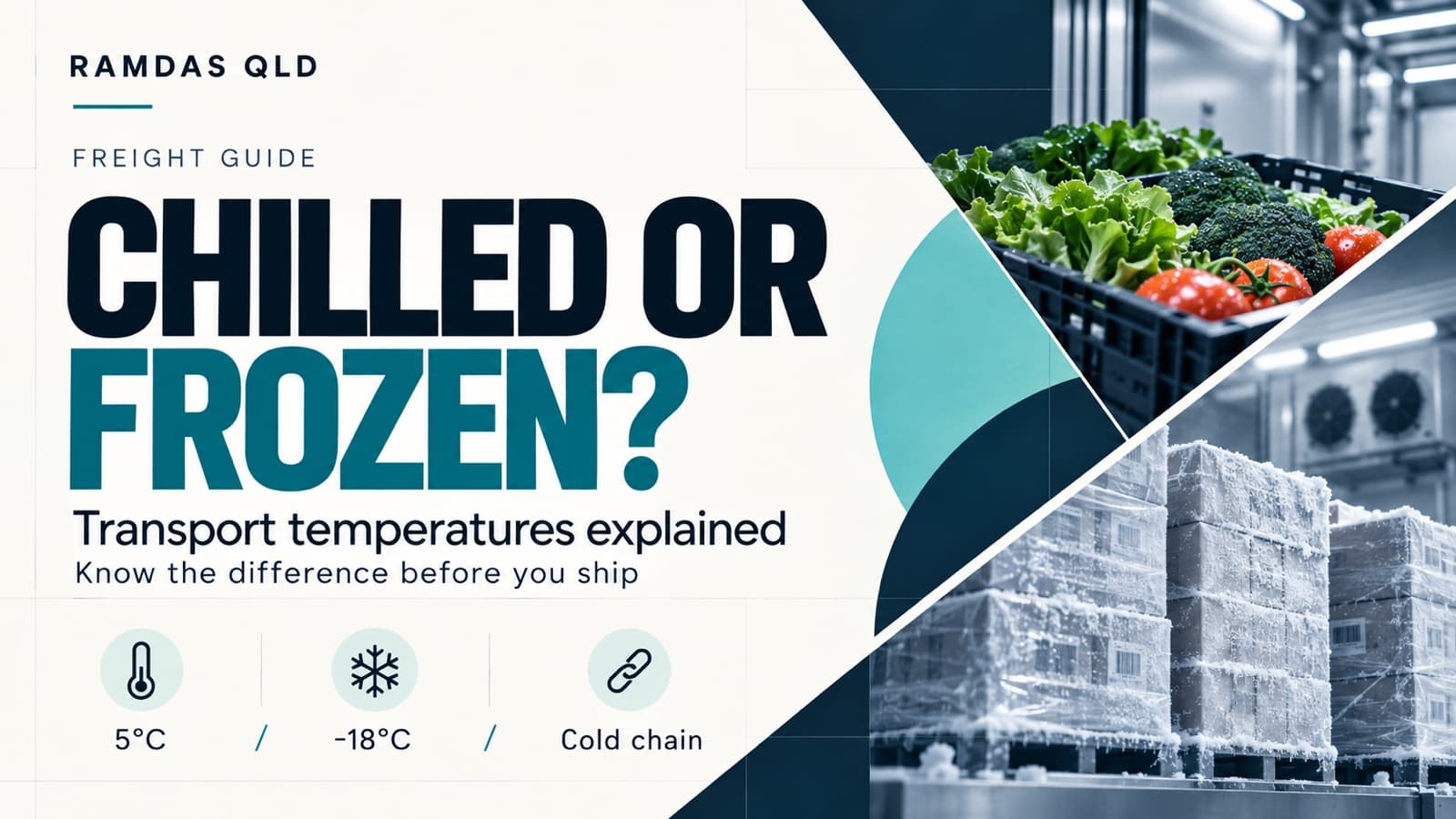
Australian food law sets one number for chilled freight and none for frozen. Standard 3.2.2 of the Food Standards Code requires potentially hazardous food to be transported under temperature control, which means 5°C or below for cold food, and requires food that is intended to be frozen to remain frozen during transport. The −18°C figure most people quote is not in the Code. It comes from the Australian Cold Chain Guidelines, an industry guide published by the Australian Food and Grocery Council (AFGC).
Both matter. The law is the floor every food business has to meet. The industry guidance is what manufacturers, retailers and receivers commonly write into their product specifications, and under those guidelines it is the product's manufacturer or owner who sets its temperature limits.
What is law and what is industry guidance
| Topic | Food Standards Code (law) | Cold Chain Guidelines (industry guidance) |
|---|---|---|
| Chilled potentially hazardous food | 5°C or below in transport, or another temperature the business can demonstrate is safe | Never warmer than +5°C and kept above 0°C; 0 to +4°C in practice |
| Frozen food | Must remain frozen during transport. No temperature figure is set | Never warmer than −18°C |
| Ice cream | Treated as frozen food: must remain frozen | Never warmer than −18°C; preferably −22°C to −30°C |
| At the receiving dock | Chilled should arrive at 5°C or below; frozen is accepted only if frozen hard | Record product temperature on receipt and on delivery, plus an air temperature log |
So a sentence like “the law requires −18°C” is wrong, but that does not make −18°C optional in practice. If your customer's specification says never warmer than −18°C, that is the number your freight is checked against at their dock.
Typical transport temperatures by product
Not everything that travels in a refrigerated truck belongs at 0–4°C. Some tropical and subtropical produce is damaged by cold, which matters in Queensland more than most places.
| Product | Typical temperature | Notes |
|---|---|---|
| Meat, poultry, seafood, dairy, egg products | 0 to 4°C | 5°C or below by law. Seafood and vacuum-packed meat are often held closer to 0°C |
| Leafy vegetables, berries | About 0 to 2°C | Cool before loading; the vehicle will not do it |
| Temperate cut flowers | About 2 to 4°C | Tropical flowers need about 13°C or warmer |
| Avocados | Hass about 5°C; Shepard about 7°C | Chilling-sensitive |
| Tomatoes | Roughly 10 to 13°C | Chilling-sensitive |
| Mangoes | About 12 to 13°C | Below 10°C risks chilling injury |
| Bananas, tropical flowers | About 13°C or warmer | Chilling injury below about 13°C |
| Chocolate | 12 to 14°C | Confectionery about +15°C |
| Frozen food | −18°C or colder | Industry guidance; the law says it must remain frozen |
| Ice cream | −22°C or colder preferred | Heat-shock damage is not reversible |
| Pharmaceuticals and vaccines | +2 to +8°C | The sponsor's labelled storage conditions govern; freezing also damages vaccines |
The truck doesn't cool your product
The Cold Chain Guidelines are blunt on this point: transport vehicles are not designed to chill product down. They maintain the temperature the product is loaded at. A pallet that leaves your coolroom at 8°C should not be expected to reach 4°C on the road.
Two things follow. Your product has to be at temperature before it is loaded, and the vehicle has to be pre-chilled to at least the never-warmer-than temperature before the doors open. We pre-cool our trailers before loading and read product temperature with a calibrated probe at pickup, so a warm pallet is found on your dock and not at your customer's.
Where temperature is lost
- Time on the dock. The guidelines set maximum out-of-refrigeration times: 20 minutes for chilled food where the dock has no refrigeration, 20 minutes for ice cream in any environment, and 20 minutes for other frozen food at room temperature. Frozen food other than ice cream gets 60 minutes in a +5 to +15°C air-conditioned anteroom, or 90 minutes in a 0 to +5°C anteroom.
- Door openings. The guidelines say to switch the refrigeration unit off while doors are open and keep doors closed between drops. Every extra drop on a run is another opening.
- Loading above the load line. The guidelines say never to load above the load line and not to block airflow, because the air moving around the load is what carries heat away.
- The warm spot. The warmest point is usually the top of the wall nearest the door. Temperature through a load can vary by more than 5°C, particularly in older vehicles.
Queensland summers make each of these worse, because the gap between dock air and product is larger. Staging pallets in the coolroom until the truck is backed in is the cheapest fix there is.
Carrying chilled and frozen on one vehicle
Mixed loads need a physical barrier. The guidelines call for insulated partitions or a dual-temperature vehicle, with frozen product positioned nearest the evaporator. Multi-temperature units use movable bulkheads and separate evaporators to hold two, sometimes three, zones.
As a thermostat guide, the guidelines suggest −22°C for the frozen zone and +2°C for chilled on runs over two hours, or +4°C on metro runs. Chilling-sensitive produce cannot share the chilled zone: bananas at 13°C and dairy at 2°C need separate compartments. Our multi-temperature service is built for split orders, and the fleet page lists the range each vehicle class can hold.
What the receiver checks, and can refuse
Under Standard 3.2.2, chilled potentially hazardous food should arrive at 5°C or below and frozen food is accepted only if it is frozen hard. Food arriving between 5°C and 60°C can be accepted only if the transporter can demonstrate that the time and temperature were safe. Otherwise the receiver must not accept it.
FSANZ's own receiving example is a useful routine: ask to see the truck's temperature data logger, probe a sample, and record the time and temperature. A food business handling potentially hazardous food must have a thermometer accurate to ±1°C to do this.
What to do next: the records to ask for
The guidelines say each link in the chain should record three things. Ask any carrier, including us, how they capture each one:
- Product temperature when the freight is received from you.
- An air temperature log for the load space during the trip, and how that log is generated.
- Product temperature at delivery.
We record calibrated probe readings at pickup and delivery, keep them on file and supply them with the proof of delivery on request. For the wider compliance picture, read HACCP and food safety questions for your carrier, and for the booking details a carrier needs, see how to book refrigerated transport.
Then write your set point and never-warmer-than limit on the booking, stage freight in the coolroom until the truck arrives, and request a quote with the product specification attached.
Frequently asked questions
What temperature does frozen food have to be transported at in Australia?
The Food Standards Code says food intended to be frozen must remain frozen during transport and does not set a number. Industry guidance in the Australian Cold Chain Guidelines is never warmer than −18°C, and most product specifications adopt that figure.
What is the 5 degree rule for transporting chilled food?
Standard 3.2.2 requires potentially hazardous food to be transported under temperature control, which for cold food means 5°C or below unless the business can demonstrate another temperature is safe. Industry guidance adds that chilled food should stay above 0°C, so carriers typically aim for 0 to 4°C.
Can a refrigerated truck cool down warm product?
No. The Australian Cold Chain Guidelines state that transport vehicles are designed to maintain the temperature product is loaded at, not to chill it. Product needs to be at temperature before loading and the vehicle pre-chilled.
Can chilled and frozen food travel on the same truck?
Yes, with an insulated partition or a dual-temperature vehicle that holds each zone separately. Frozen product sits nearest the evaporator and each zone runs to its own set point.
Can a receiver reject a delivery that arrives above 5°C?
Yes. Chilled potentially hazardous food arriving between 5°C and 60°C can be accepted only if the transporter can demonstrate the time and temperature were safe. If they cannot, the receiver must not accept it.
Ramdas QLD dispatch team
Refrigerated transport, Brisbane
Written by the people who plan and run Ramdas QLD's chilled, frozen and multi-temperature freight across Brisbane and Queensland. About us
Sources
- FSANZ — Safe Food Australia (guide to Standard 3.2.2)
- FSANZ — 2-hour/4-hour rule
- AFGC — Australian Cold Chain Guidelines 2017
- Department of Health — National Vaccine Storage Guidelines: Strive for 5
General information only — check the current standard or your regulator for requirements that apply to your product.