Key takeaways
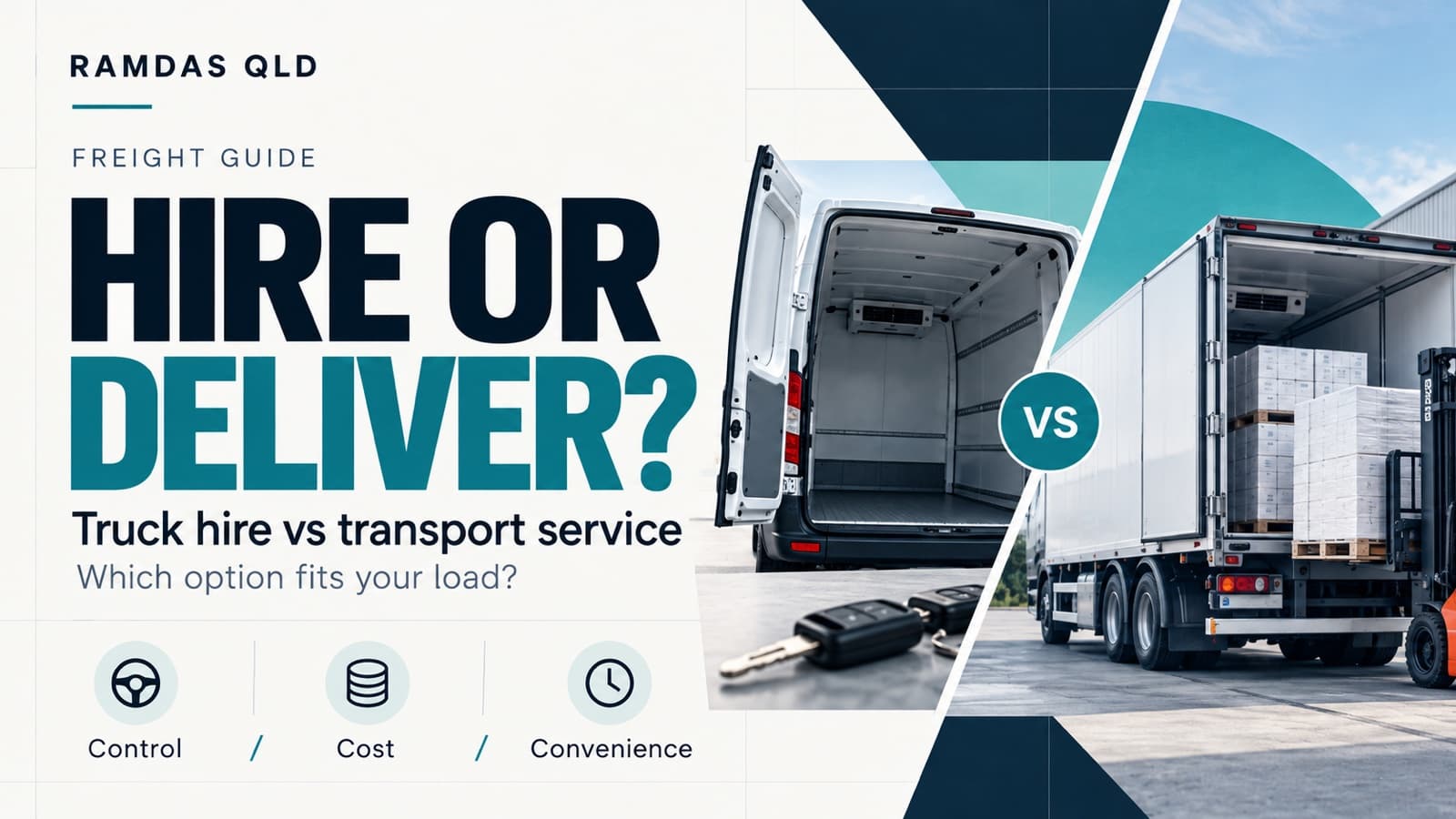
- Hire gives you a refrigerated vehicle to operate yourself; a transport service gives you a completed delivery.
- The daily hire rate is only part of the cost: add driver time, fuel, pre-cooling, cleaning and insurance excess.
- When you drive a hired vehicle, your business is the transporter and keeps the temperature records.
- Hire suits events, market stalls and regular runs with your own staff; a carrier suits one-off, multi-drop, long-distance and frozen freight.
- Ramdas QLD is a carrier and does not hire out vehicles.
On this page
Hire a refrigerated truck or van when you need cold space that stays with you: parked at an event, behind a market stall, or driven by your own staff on a route you run every week. Book a refrigerated transport service when you need product moved from one address to another and delivered at temperature, with someone else supplying the driver, the vehicle and the records.
We should be plain about where we sit. Ramdas QLD is a carrier, and we don’t hire out vehicles. Hire is still the better answer for some jobs, and this guide sets out which ones.
What each option actually includes
Refrigerated truck or fridge van hire gives you a vehicle with a working refrigeration unit for a set period. You collect it, pre-cool it, load it, drive it, monitor it, clean it and return it. What goes in the back and what temperature it is kept at are your decisions.
A refrigerated transport service gives you a completed delivery. The carrier chooses a suitable vehicle, pre-cools it, collects your freight, carries it at the temperature you specify and delivers it with proof of delivery. On our runs, calibrated probe temperatures are read and recorded at pickup and delivery, and dispatch sends SMS or email updates along the way.
The real cost of hiring a refrigerated vehicle
The advertised hire rate is the visible part of the cost. Before comparing it with a freight quote, add the parts that don’t appear on the hire invoice.
- Driver’s time. Someone on your payroll is out of the kitchen, shop or packing shed for the collection, the run and the return.
- Licence. A refrigerated van can usually be driven on a car licence, but trucks may need a heavier licence class, depending on the vehicle. Confirm the licence class for the exact vehicle with the hire company and your state licensing authority before you book.
- Fuel. The vehicle uses fuel, and so does the refrigeration unit on many vehicles. Hire vehicles normally go back refuelled.
- Insurance excess. Read the hire agreement for the damage excess and for what it says about the goods. Vehicle cover does not usually extend to the stock you are carrying.
- Pre-cooling time. The body has to be brought down to temperature before anything is loaded. A refrigerated vehicle is designed to hold product at the temperature it was loaded at, not to chill it down.
- Cleaning. The load space has to be clean before food goes in and is normally expected clean on return.
- Temperature records. These become your job, which is the subject of the next section.
If the hired truck is large enough to be a heavy vehicle, the driver’s work and rest hours are also regulated. That matters on a long regional run with one driver.
Who is responsible for the cold chain
This is the difference people most often overlook. Under the Food Standards Code, a food business must transport potentially hazardous food under temperature control, which means 5°C or below for chilled food, and frozen food must stay frozen. When you drive a hired vehicle, your business is the one doing the transporting.
In practice that means you need a thermometer accurate to ±1°C, a check of product temperature at loading and at delivery, and a record you can show a customer or an auditor. If the unit fails on the highway or the set point was wrong, the product and the decision about what to do with it are yours.
With a carrier, the transport leg is the carrier’s to manage and document. You still own the product specification: the manufacturer or owner sets the temperature limits, and you need to hand freight over already at temperature. Our guide to the food safety questions to ask a carrier lists the documents worth requesting from any transport company, including us.
Hire vs transport service at a glance
| Vehicle hire | Transport service | |
|---|---|---|
| What you get | A refrigerated vehicle for a set period | A delivered consignment |
| Driver | You or your staff | Supplied by the carrier |
| Licence | Yours must suit the vehicle | Not your concern |
| Pre-cooling and cleaning | You | Carrier |
| Temperature checks and records | You | Carrier, available with POD on request |
| Fuel and tolls | You pay directly | Built into the quote or itemised |
| Priced by | Time, usually with a kilometre allowance | The run: distance, space, weight, drops |
| Stationary cold storage | Yes, for as long as you have it | No |
| Multi-drop routes | You plan and drive them | Planned by dispatch |
| Best suited to | On-site storage and regular own-staff runs | One-off, irregular, long or frozen freight |
When hiring is the better choice
- Events that need cold storage on site. A festival, wedding or sporting weekend where stock has to stay cold beside the kitchen for a day or more. A carrier delivers and leaves; a hired vehicle stays.
- Market stalls. You load at your premises, sell from the stall all day and take the unsold stock home in the same vehicle.
- Regular, predictable runs with your own staff. If you have a licensed driver with spare hours and the same route every week, the sums can favour hire or a long-term lease.
- Product you want to stay with. Some businesses want their own person at the delivery, setting up a display or checking stock with the customer.
When a carrier is the better choice
- One-off or irregular freight. You pay for the run rather than for a vehicle and a day of someone’s time.
- Multi-drop deliveries. Route planning, unloading and door discipline across several stops is routine work for a carrier and a long day for a chef.
- Longer distances. Regional Queensland runs involve fatigue rules, fuel planning and a return trip. See our Brisbane to Cairns freight guide for what that distance involves.
- Frozen freight. Holding frozen product through loading, transit and door openings leaves less margin for error than chilled, and not every hire vehicle is built for it.
- Chilled and frozen together. A multi-temperature vehicle carries both in separate zones.
- Anything a customer wants temperature records for. The carrier supplies them as part of the job.
What to do next
Work out the full cost of the hire option for your job: the hire rate, plus the hours of whoever drives, plus fuel, plus the time to pre-cool and clean. Then get a freight quote for the same job and compare the two totals. Our article on refrigerated transport costs in Queensland explains what a carrier will ask you.
If the carrier option looks right, send the details through our quote form. If hire is the better fit, a vehicle hire company is the right call, and we would rather tell you that than quote a job that doesn’t suit.
Frequently asked questions
Is it cheaper to hire a refrigerated van or use a refrigerated courier?
It depends on the job. Hire can cost less for regular runs with your own staff, while a courier is often cheaper for one-off deliveries once you add driver time, fuel, pre-cooling and cleaning to the hire rate.
Does Ramdas QLD hire out refrigerated trucks or vans?
No. Ramdas QLD is a refrigerated transport carrier, so we supply the vehicle and the driver and deliver the freight for you.
Do I need a special licence to drive a hired refrigerated truck?
A van can usually be driven on a car licence, but trucks may need a heavier licence class, depending on the vehicle. Confirm the requirement for the specific vehicle with the hire company and your state licensing authority.
Who is responsible for food temperature in a hired fridge van?
You are. When your business drives the vehicle it is the transporter, so it must keep potentially hazardous food under temperature control and should record product temperatures.
Can I use a hired refrigerated truck as cold storage at an event?
Yes, and it is one of the best uses of hire. Check with the hire company how the refrigeration unit is powered while the vehicle is parked.
Ramdas QLD dispatch team
Refrigerated transport, Brisbane
Written by the people who plan and run Ramdas QLD's chilled, frozen and multi-temperature freight across Brisbane and Queensland. About us
Sources
- FSANZ — Safe Food Australia (guide to Standard 3.2.2)
- Australian Cold Chain Guidelines 2017 (AFGC)
- NHVR — Standard hours (work and rest requirements)
General information only — check the current standard or your regulator for requirements that apply to your product.