Key takeaways
- Brisbane to Cairns is about 1,700 km by road, almost all of it on the Bruce Highway.
- Driver fatigue law means the run takes more than one driving shift, so it is never a simple overnight delivery.
- Direction matters: freight flows are uneven, and backload space affects both availability and price.
- Bananas and mangoes need warmer set points than chilled food and cannot share a 0–4°C zone.
- From November to April, build buffer time for flood closures and decide where freight can be held.
On this page
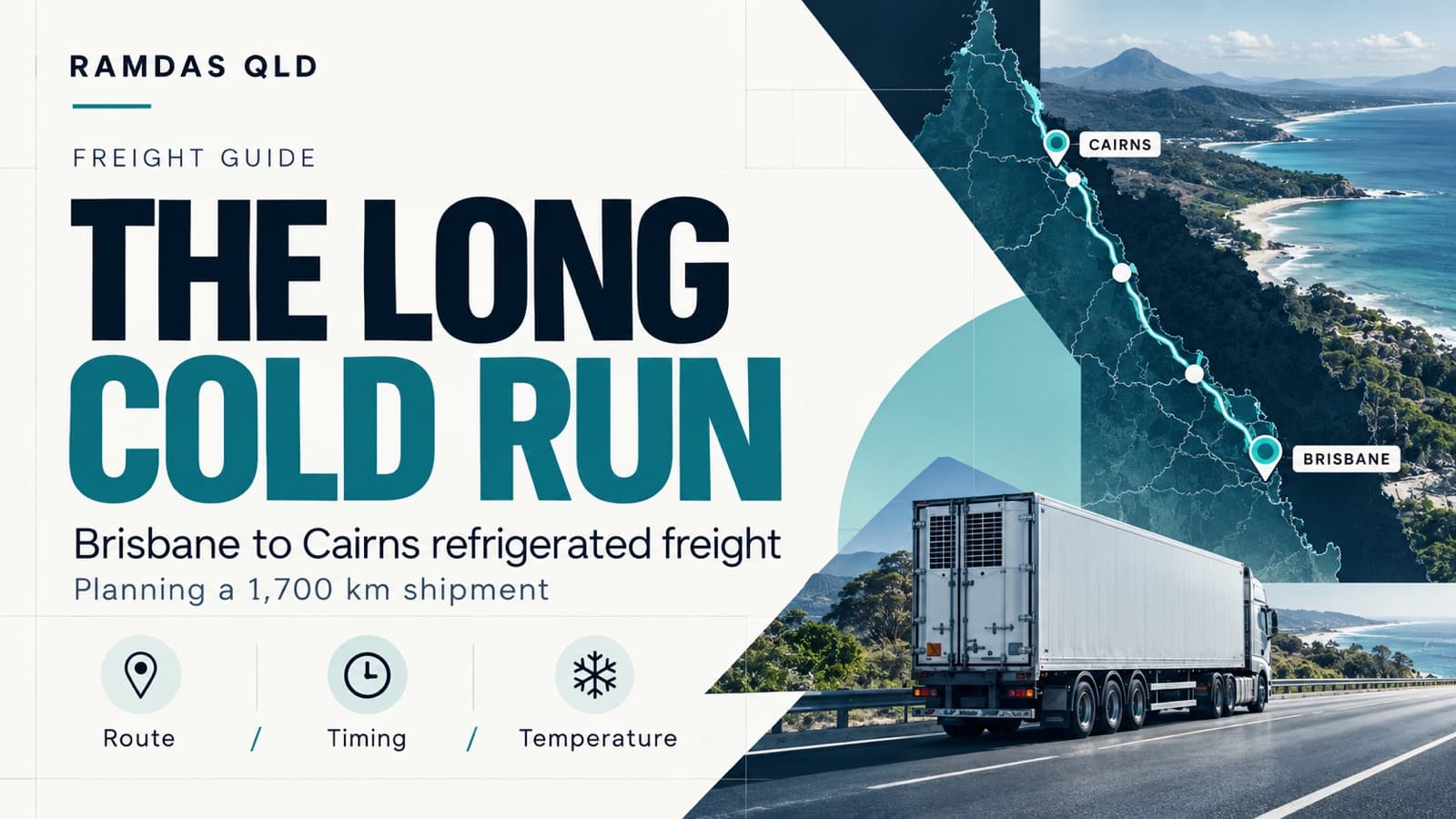
Refrigerated freight from Brisbane to Cairns travels about 1,700 km, almost entirely on the Bruce Highway. It is a planned linehaul run, not an overnight delivery: fatigue law limits how long a driver can work, the product has to hold temperature for the whole trip, and for part of the year the highway floods.
None of that makes the run difficult to book. It does mean the details you give at the quote stage, such as temperature, pallet count, delivery windows and how much flexibility you have, decide what service fits. Ramdas QLD runs regional Queensland linehaul on planned and scheduled services, so the first step is to contact us with the route and we will confirm availability.
The route: Brisbane to Cairns on the Bruce Highway
The Bruce Highway runs about 1,670 km between Brisbane and Cairns and links every major centre on the Queensland coast. Most refrigerated freight to North Queensland is dropped or collected somewhere along it.
| Centre | Approx. distance from Brisbane | Cold freight in the region |
|---|---|---|
| Bundaberg | About 360 km | Macadamias and sweet potato heading out |
| Rockhampton | About 630 km | Central Queensland drop point for chilled and frozen deliveries |
| Mackay | About 965 km | Bowen–Gumlu district to the north: tomatoes and capsicums, harvest roughly May–November |
| Townsville | About 1,360 km | Tully–Innisfail, which grows most of Australia's bananas, lies between here and Cairns |
| Cairns | About 1,700 km | Mareeba–Dimbulah and the Atherton Tablelands inland: mangoes, peak about late December–January |
Why it isn't an overnight run
Heavy vehicle fatigue law sets how long a driver can work. Under standard hours, a solo driver can work a maximum of 12 hours in any 24-hour period and must take 7 continuous hours of stationary rest in that period. Shorter limits apply inside the shift too: no more than 5¼ hours of work in any 5½ hours.
A run of about 1,700 km does not fit inside one of those shifts. It needs rest breaks on the way, or more than one driver. Transit time therefore depends on the service, the number of drops and how the run is crewed. We do not publish a transit time for that reason; we confirm it for your freight when we quote.
This is your concern as well as ours. Under Chain of Responsibility, a business that consigns or receives goods by heavy vehicle has a duty to ensure, so far as reasonably practicable, the safety of its transport activities. In practice that means not setting a delivery deadline that could only be met by speeding or skipping rest.
Northbound, southbound and backloads
Freight on this corridor is not balanced. Northbound trucks typically carry consumer goods, chilled food and frozen product for shops, food service and distributors. Southbound, much of the refrigerated freight is fresh produce heading for the Brisbane Markets at Rocklea and beyond, and that volume rises and falls with each harvest.
A truck that delivers in the north needs a load to bring home, known as a backload. When trucks are short of freight in one direction, space in that direction is easier to find and generally priced more keenly. When a harvest peaks, space out of that region tightens. Booking early in peak season matters more than anything else you can do. Our guide to refrigerated transport costs in Queensland explains the other factors behind a quote.
Holding temperature over a long run
A long trip gives small mistakes more time to do damage. The basics come from the industry's Australian Cold Chain Guidelines:
- Product at temperature before loading. Transport vehicles maintain the temperature product is loaded at; they are not designed to chill it down.
- A pre-cooled trailer. The load space should be chilled to at least the product's never-warmer-than temperature before loading. We pre-cool our trailers before loading.
- Clear airflow. Nothing stacked above the load line or blocking the air path.
- As few door openings as possible. Each drop on the way lets heat in, so drop order and load plan matter.
- Continuous-run for produce. Running the unit continuously is generally preferred for fresh produce because it keeps air moving through the load.
Wet season and cyclone risk
The Bureau of Meteorology's tropical cyclone season runs from November to April. In the same months the Bruce Highway is prone to flood closures, with well-known trouble spots including Goorganga Plains near Proserpine and the stretch north of Ingham. A closure can hold trucks on either side until the water drops.
For freight that has to arrive, plan for it:
- Build buffer into delivery dates across the wet season, especially for events, promotions and short shelf-life product.
- Agree in advance where freight is held if the road closes, and who makes that call. Where a partner facility is available, we can arrange cold storage and cross-docking; ask us what exists on your route.
- Make sure the receiver can take a late delivery, including outside normal hours.
- Keep phone numbers current. Our dispatch sends SMS and email updates at pickup, in transit and at delivery, and supports active runs around the clock.
Part loads and full loads
You do not need a full trailer to send freight north. A part load shares the vehicle with other consignments, which suits a few pallets but ties you to the timing of a planned service and usually means more door openings on the way. A full load runs to your timing and opens only at your addresses.
For scale, a semi-trailer typically carries 22–24 standard pallets (1165 × 1165 mm), and chilled or frozen food usually cannot be double-stacked. Weight can limit a load before floor space does. Our guide to part-load refrigerated pallet freight covers when sharing makes sense.
What to do next: what to send us
A quote for a long regional run is only as good as the details behind it. Send these through the quote form or call dispatch:
- Pickup and delivery towns and addresses, and whether either site has a forklift or dock.
- Product, and its set point and never-warmer-than temperature.
- Pallet count, pallet height and total weight.
- The date freight is ready, and the latest date it can arrive.
- Receiving hours at the delivery end, and any booking-in rules.
- Whether it is a one-off or a regular run.
We respond to quote requests within 24 hours, often the same day for routine routes, and will tell you plainly whether a planned service fits your dates.
Frequently asked questions
How long does refrigerated freight take from Brisbane to Cairns?
It depends on the service, the number of drops and how the run is crewed, so we confirm transit time when we quote. At about 1,700 km it cannot be driven within a single legal work shift, so it is not an overnight delivery.
How far is it from Brisbane to Cairns by road?
About 1,700 km, almost all on the Bruce Highway. Approximate distances from Brisbane to centres on the way are Rockhampton 630 km, Mackay 965 km and Townsville 1,360 km.
Can I send just a few pallets of frozen freight to Townsville or Cairns?
Yes, as a part load that shares a vehicle with other freight on a planned service. Availability depends on the route and dates, so contact us with the pallet count and temperature.
Can bananas or mangoes travel with chilled food?
Not in the same temperature zone. Bananas are injured below about 13°C and mangoes are typically carried at about 12–13°C, so they need a separate compartment on a multi-temperature vehicle or their own load.
What happens to my freight if the Bruce Highway floods?
The truck may have to wait or the freight may need to be held under refrigeration until the road reopens. Between November and April, agree a holding plan and allow buffer time before you send.
Ramdas QLD dispatch team
Refrigerated transport, Brisbane
Written by the people who plan and run Ramdas QLD's chilled, frozen and multi-temperature freight across Brisbane and Queensland. About us
Sources
- NHVR — Standard hours (work and rest requirements)
- NHVR — Chain of Responsibility
- AFGC — Australian Cold Chain Guidelines 2017
- Bureau of Meteorology — Tropical cyclones
General information only — check the current standard or your regulator for requirements that apply to your product.