Key takeaways
- HACCP certification is not a blanket legal requirement for food transporters; it is usually set by customers and contracts.
- The law that applies to every food business is the Food Standards Code, including the transport and receipt rules in Standard 3.2.2.
- Transporting meat, eggs, dairy, seafood or horticulture produce in Queensland may require a Safe Food accreditation: confirm for your product.
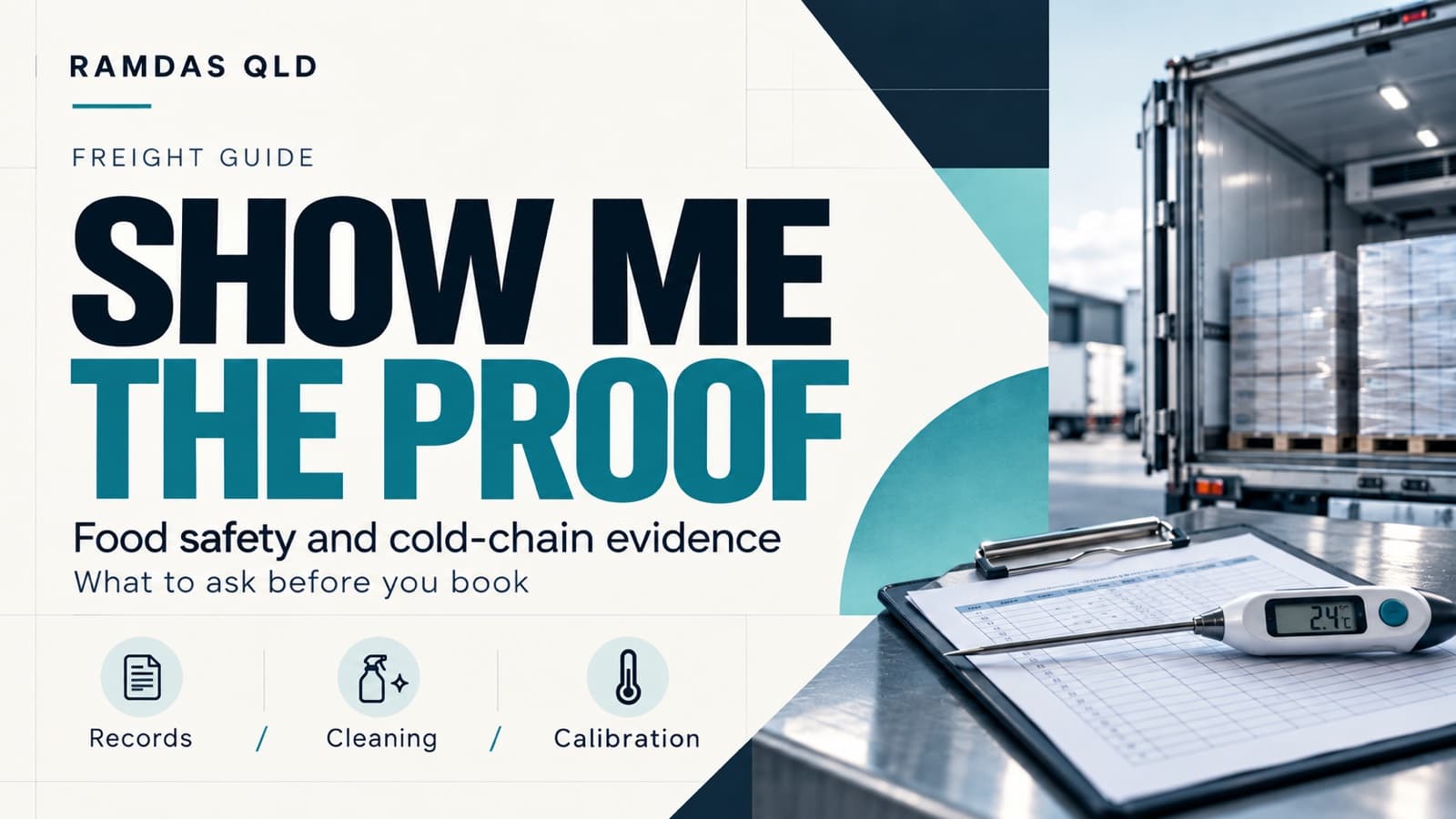
- Ask for evidence, not adjectives: temperature records, cleaning records, probe calibration and current certificates.
- As the consignor you keep duties of your own, for food safety and under Chain of Responsibility.
On this page
Before you book a refrigerated carrier, ask for evidence of how they control temperature and hygiene, and check whether your product needs anything more. HACCP certification is not a blanket legal requirement for food transporters in Australia. It is usually something a customer, retailer or contract asks for. What the law does require of every food business is compliance with the Food Standards Code.
That distinction changes the questions worth asking. “Are you HACCP certified?” gets a yes or a no. “Show me the temperature record from a recent delivery” tells you how the truck is actually run.
What HACCP is, in plain English
HACCP stands for Hazard Analysis and Critical Control Points. It is the Codex seven-principle system for finding where food can become unsafe and controlling those points:
- Hazard analysis. List what could go wrong with the food at each step.
- Critical control points. Pick the steps where control is essential.
- Critical limits. Set a measurable limit for each one, such as a maximum temperature.
- Monitoring. Check the limit is being met, and write it down.
- Corrective action. Decide in advance what happens when a limit is missed.
- Verification. Confirm the system works, for example by calibrating thermometers.
- Record keeping. Keep the records so the checks can be shown later.
What that looks like on a truck
Transport has only a handful of points where food safety is won or lost. A carrier working to HACCP principles will typically treat these as its control points:
- Product temperature at pickup, read with a probe before the freight is accepted.
- Vehicle pre-cool, so the load space is at temperature before the doors open.
- Air temperature in the load space during transit.
- Product temperature at delivery, recorded with the time.
- Cleaning and changeover between loads, particularly between sensitive products.
What the law requires of food transport
All food businesses must comply with the Food Standards Code, whatever their licensing. For transport, Standard 3.2.2 says potentially hazardous food must be transported under temperature control, which means 5°C or below for chilled food (or another temperature the business can demonstrate is safe), and food intended to be frozen must remain frozen.
On receipt, chilled potentially hazardous food should arrive at 5°C or below and frozen food is accepted only if frozen hard. Food arriving between 5°C and 60°C can be accepted only if the transporter can demonstrate the time and temperature were safe. A food business handling potentially hazardous food must also have a thermometer accurate to ±1°C. The numbers are covered in detail in our guide to chilled and frozen transport temperatures.
What customers and retailers require by contract
Over the top of the law sits whatever your customers specify. Supply agreements and product specifications commonly ask for a HACCP-based food safety program, tighter temperature limits than the Code, such as frozen never warmer than −18°C from the industry's Australian Cold Chain Guidelines, and particular records. If your customer requires a certified carrier, that requirement comes from them, so ask for it in writing and pass it on when you request a quote.
Safe Food Queensland accreditation
Queensland has a further layer for some products. Safe Food Production Queensland's guidance is that businesses transporting meat, eggs, dairy, seafood or horticulture produce in Queensland may require an accreditation.
Whether one applies depends on the product and the activity, so we will not generalise here. Confirm the position for your product directly with Safe Food Queensland, then ask your carrier for the current certificate if one is needed.
Your own obligations as the product owner
Handing freight to a carrier does not hand over your responsibilities. Your business must still comply with the Food Standards Code, and the Cold Chain Guidelines put the temperature limits for a product in the hands of its manufacturer or owner. That means giving the carrier a set point and a never-warmer-than limit in writing.
If freight is delivered to you, you are the receiver. FSANZ's receiving example is worth copying: ask to see the truck's temperature data logger, probe a sample, and record the time and temperature.
There is also heavy vehicle law. Under Chain of Responsibility, a business that consigns or receives goods by heavy vehicle is a party with a primary duty to ensure, so far as reasonably practicable, the safety of its transport activities. In practice: do not set delivery deadlines that require speeding or skipped rest, declare weights accurately, and load safely.
Documents to request, and what each one proves
| Ask for | What it proves |
|---|---|
| Product temperature record at pickup and delivery | Freight was at temperature when accepted and when handed over, with a time against each reading |
| In-transit air temperature record, and how it is generated | What happened between the two probe readings |
| Cleaning and changeover records | The load space was cleaned before your product went in, and what was carried before it |
| Probe calibration record | The thermometer behind every reading is accurate. Food businesses handling potentially hazardous food must have one accurate to ±1°C |
| Accreditation or certification certificates, where they apply to your product | A third party has audited the carrier against that scheme. Check the expiry date and scope |
| Insurance certificate of currency | Cover is in place today. Ask what the policy does and does not cover for temperature-related loss |
| Written procedure for a temperature breach | Someone has decided in advance who is called and what happens to the freight |
Red flags
- Temperature is described from the cab display only, with no probe reading of the product.
- Records are promised “if there's a problem” but cannot be produced for an ordinary delivery.
- Nobody can say when the probe was last calibrated.
- The carrier is happy to load warm product and “bring it down on the way”. Refrigerated vehicles maintain temperature; they are not designed to chill product.
- Claims of certification or accreditation with no certificate, or one that has expired.
- No clear answer on what was in the vehicle before your load, or how it was cleaned.
What to do next
- Write down your product's set point and never-warmer-than limit, and any carrier requirements in your customers' specifications.
- Check with Safe Food Queensland whether transporting your product requires an accreditation.
- Send the table above to the carriers you are comparing and ask for a recent example of each record.
- Probe and record your own freight at dispatch, so there is a reading from both sides.
Our guide to choosing a refrigerated transport company in Brisbane covers the commercial side of the comparison. To see how we handle a load, read about our refrigerated transport services and how job updates and proof of delivery work, then contact us with your product details.
Frequently asked questions
Does a refrigerated transport company have to be HACCP certified in Queensland?
HACCP certification is not a blanket legal requirement for food transporters. It is usually required by customers, retailers or supply contracts, while every food business must still comply with the Food Standards Code.
Does my carrier need Safe Food Queensland accreditation?
Safe Food Production Queensland says businesses that transport meat, eggs, dairy, seafood or horticulture produce in Queensland may require an accreditation. Confirm the position for your product with Safe Food Queensland and ask the carrier for the current certificate if one applies.
What food safety documents should I ask a refrigerated carrier for?
Ask for recent product temperature records at pickup and delivery, an in-transit air temperature record, cleaning records, probe calibration records, any accreditation certificates that apply to your product, and an insurance certificate of currency.
Who is responsible if food arrives out of temperature?
It depends on the records and on your contract and the carrier's terms. Under Standard 3.2.2 the receiver must not accept potentially hazardous food that arrives between 5°C and 60°C unless the transporter can demonstrate the time and temperature were safe, which is why readings from both dispatch and delivery matter.
How does Ramdas QLD handle food safety on its trucks?
We describe our handling as HACCP-aligned: probe temperatures recorded at pickup and delivery, pre-cooled vehicles, and cleaning and changeover between sensitive loads. Ask us for the current documents relevant to your product before you book.
Ramdas QLD dispatch team
Refrigerated transport, Brisbane
Written by the people who plan and run Ramdas QLD's chilled, frozen and multi-temperature freight across Brisbane and Queensland. About us
Sources
- FSANZ — Safe Food Australia (guide to Standard 3.2.2)
- AFGC — Australian Cold Chain Guidelines 2017
- Safe Food Production Queensland — FAQ
- NHVR — Chain of Responsibility
General information only — check the current standard or your regulator for requirements that apply to your product.